Duette Honeycomb Shades: Cost, Quality, and the Downsides
Duette is the insulation-first shade in the Hunter Douglas line: the one that earns its premium when a room is cold at the glass, hot in the afternoon sun, or too bright to sleep in. It is harder to justify when the job is keeping a view or covering glass for the lowest price. The full working, with Luxe's own published prices, the energy numbers with their conditions attached, and the downsides stated plainly.
By Mark Abplanalp
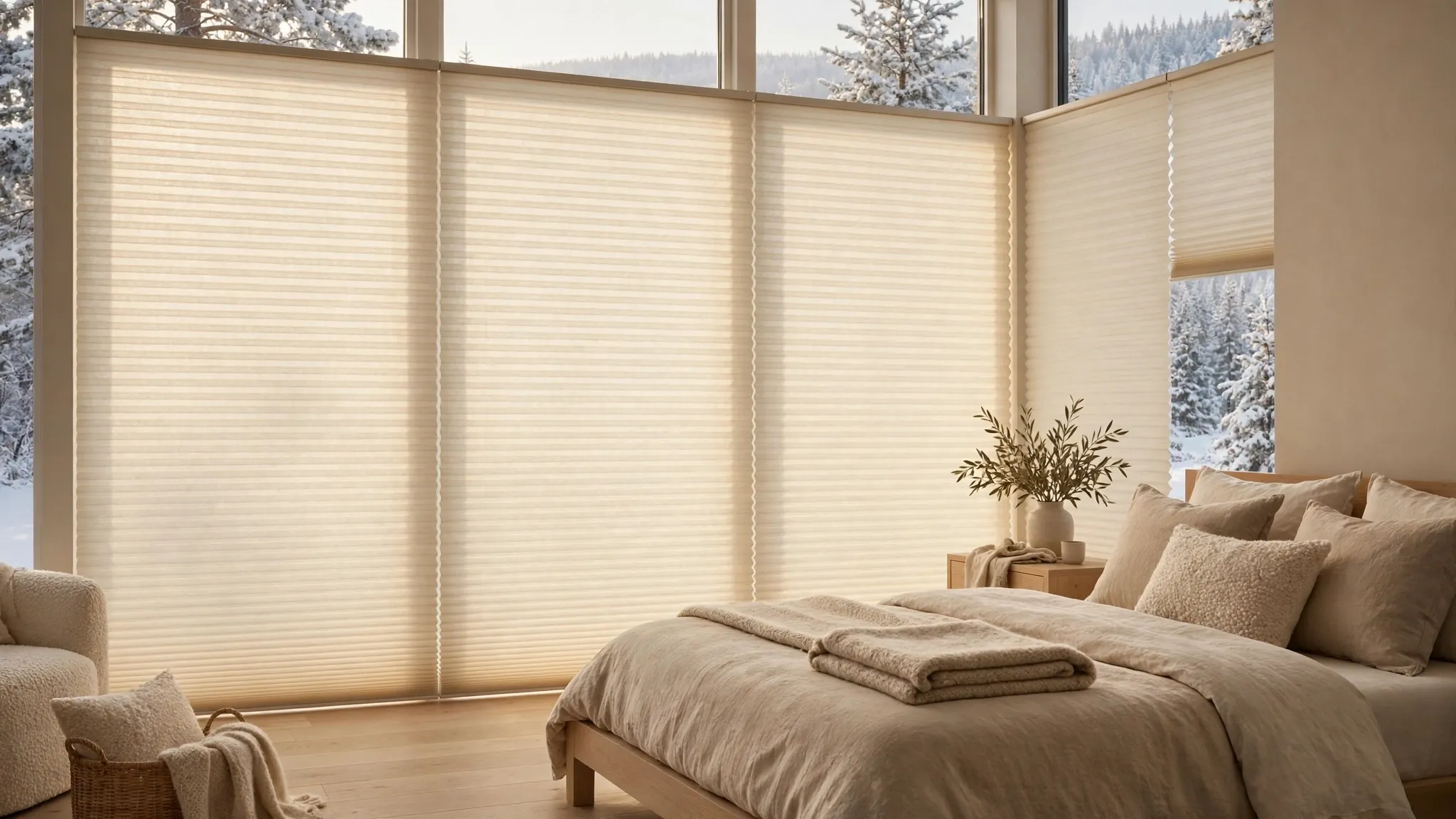
The short answer: Duette is the shade you buy when the window itself is the problem. If a room is cold at the glass in winter, bakes in the afternoon sun, or lets in too much light for sleep, Duette's honeycomb construction is built for exactly that, and it earns its premium there. If the job is keeping a view while the shade is down, or covering glass for the lowest possible price, Duette is the wrong tool and this article will say so plainly, with the downsides named instead of buried. What follows is the full working: what Duette costs in our own published ranges, what the quality premium actually buys, what the energy numbers really promise and what they depend on, and where this product loses.
What you are actually paying for
A Duette shade is a honeycomb. Seen from the side, the fabric forms a row of enclosed cells, and those cells trap air in distinct pockets right at the glass. Still air is insulation, so the shade becomes an insulating layer between the room and the window. Duette is Hunter Douglas's original cellular shade, and the construction has been refined for decades rather than replaced.
The top of the line is Architella, a honeycomb within a honeycomb: a cell inside a cell. Hunter Douglas calls Architella the most energy efficient style it makes, and the independent ratings back the ordering. The Attachments Energy Rating Council, which rates window coverings for energy performance, publishes a median U-factor of 0.24 for Architella against 0.36 for a standard honeycomb, on the same baseline window. Lower is better, and that gap is the measurable version of what the premium buys.
Quality also shows in the range behind the product. In Hunter Douglas's own comparison, Duette carries a wide variety of fabrics, colors, and pleat sizes, where its value sibling Applause offers a limited selection and single or limited double-cell construction. Translated out of brochure language: Duette is the line you choose when the fabric has to be right, not merely close, and when the cell structure has to perform, not merely cover.
Two options extend what the base shade does, and both are options, not standard equipment. LightLock adds U-shaped side channels with rows of micro-ridges that absorb or deflect nearly all incoming light, and the same seal cuts air movement at the opening. Duolite combines two fabrics of different opacities in one shade, a light-filtering front and a room-darkening back, so one window can do day and night duty. Duette also absorbs up to 70 percent of sound energy, which matters in street-facing rooms and media rooms more than most people expect. Operating choices cover the awkward glass too: top down bottom up for privacy with light from above, Vertiglide for sliding doors and wide expanses, and PowerView motorization when the shades need to move on a schedule.
What Duette costs
Our Hunter Douglas cost guide publishes the ranges, and this article stays inside them. Duette runs about $300 to $800 per window depending on size, fabric, and construction. PowerView motorization adds roughly $300 to $600 per window, and a fully motorized Duette commonly lands between $500 and $1,200 per window all-in at standard sizes.
A room makes the math concrete. A primary bedroom with four standard windows, in a manual Duette with a mid-tier fabric, runs roughly $1,200 to $3,200 for the room. The same room with PowerView runs roughly $2,400 to $5,600.
Where you land inside the range is mostly about construction. Single-cell fabrics in standard colors sit at the low end. Architella cell-within-a-cell construction, LightLock channels, and Duolite two-fabric designs sit at the top, because each one adds material and mechanism that does a specific job. The honest way to read the range: you are not paying for the Hunter Douglas name in the abstract, you are paying for cell structure, fabric choice, and sealing, and each step up buys a measurable thing. Whether that thing matters in your room is the next two sections.
The energy claim, with its conditions
Window coverings get sold on energy promises, so here are the numbers with their sources and their strings attached.
The U.S. Department of Energy's Energy Saver program states that windows are responsible for 25 to 30 percent of residential heating and cooling energy use, and that tightly installed cellular shades can reduce heat loss through windows by 40 percent or more, which translates to roughly 10 percent savings on heating energy. In the cooling season, the same source credits cellular shades with reducing unwanted solar heat gain by up to 60 percent. The Department of Energy's own cold-weather guidance points readers to insulated cellular shades for drafty windows and to AERC ratings for comparing products, which is the same rating behind the Architella figures above.
Now the conditions, because they decide whether you see any of that. A cellular shade insulates only when it is lowered. A Duette raised at the headrail for the whole heating season returns nothing, no matter what it cost. Fit matters the same way, and here the mounting choice cuts against instinct. Insulation wants the shade close to the glass and sealed at the sides, which is what the tight installation in the Department of Energy's phrasing is really describing. An inside mount sits closest to the glass; its weakness is the gap at each side, and LightLock channels are the fix because they seal exactly those edges. An outside mount does the opposite: it stands off the wall with its sides open to the room, air circulates behind the shade, and it insulates worse, whatever it does for covering light gaps. This is also the practical case for PowerView scheduling on this product specifically: shades that lower themselves at dusk actually deliver the insulation a manual shade only promises. Our cellular shades energy guide goes deeper on the planning side, and our cellular vs. roller comparison covers the other direction shoppers usually cross-shop.
The darkness ladder
Duette gets asked to do bedroom duty constantly, so the light story deserves the same honesty. A standard light-filtering Duette softens light; it does not darken a room, and like any inside-mount shade it leaks light at the edges. Real darkness is a ladder, and each rung adds something specific. An opaque, room-darkening fabric stops light through the shade itself. LightLock channels then close the edge gaps the fabric cannot. Duolite takes a different route, pairing a light-filtering front fabric with a room-darkening back fabric in a single shade, so the window filters light by day and darkens at night without a second product. Ordered knowingly, a Duette with the right fabric and LightLock is a genuinely dark bedroom shade. Ordered as a base light-filtering shade and expected to black out, it disappoints, and that mismatch is the single most common Duette mistake. Our blackout shades guide walks the full darkness question across product types.
The downsides, stated plainly
The price is real. Duette is Hunter Douglas's premium cellular line, and the published range proves it: $300 to $800 a window before motorization, with Architella, LightLock, and Duolite all sitting at the top of the range as paid steps, not included features. If the budget is the main constraint, a value cellular line covers a window for less, and inside our own showroom that conversation is usually about Alta, Hunter Douglas's value brand. Paying Duette money for a window whose only job is basic privacy is not a purchase we will talk you into.
There is no view through it. A lowered Duette is a fabric wall, translucent or opaque depending on the fabric. Unlike Silhouette, which keeps your view out while it softens the light, a Duette gives you the view only when it is raised. Duolite's sheer front softens that tradeoff without removing it. On the glass you bought the house for, this is a genuine reason to choose something else.
The base shade is not a blackout shade. As the ladder above lays out, darkness is an ordered configuration, not a default. Anyone quoting a standard Duette as a blackout solution is skipping steps.
The insulation is use-dependent. Raised shades do not insulate, and a loose fit leaks away part of the benefit. The energy case for Duette is real and rated, and it still depends on the shades being down and fitted tightly, which is an installation and habit question, not just a product question.
The look is not for everyone. A Duette reads as clean, pleated fabric: modern, quiet, architectural in a flat way. It does not have the softness of drapery or the structure of shutters. That is a taste judgment rather than a defect, and it is exactly the kind of thing samples in the room settle in about thirty seconds.
Where we spec Duette first, and where we steer you away
After two decades of specifying and installing these products, our Duette recommendations sort themselves by the room's problem, not by the product's brochure.
Duette goes first on the windows that fight the house: the bedroom that is cold in the morning, the west-facing glass that overheats a living room every afternoon, the drafty original windows in an older home where replacement glass is not in the plan. It goes first in bedrooms that need real darkness, ordered with the opaque fabric and LightLock rather than wished into blackout. And it goes first on street-facing windows and in media rooms, where the sound absorption does quiet work nobody puts on a spec sheet.
We steer away from Duette where the view is the point of the window. A lake view or a mountain view behind a lowered honeycomb is a view you have paid to cover, and a sheer shading or a roller shade serves that glass better. We steer away where the budget is the honest headline, because a value cellular shade that fits the budget beats a premium one that strains it. And we steer away where the room wants softness: some rooms are drapery rooms, and no cellular shade, however well made, gives a room what fabric panels give it.
That sorting, more than any single feature, is the worth-it answer. Duette is worth its price on the windows where insulation, darkness, or quiet is the job. Elsewhere, the same money buys more happiness spent on a product built for the job that room actually has.
One service, wherever you are
Luxe Window Works serves North Idaho, Seattle's Eastside, and the Salt Lake area, and the service story is the same in every market. We bring the Duette samples to your home for a free consultation, so you can hold the fabrics against your own glass, feel which windows run cold, and judge the darkness ladder in the room that has to sleep. We measure precisely, and installation runs through our partnership with Hunter Douglas Installation Services. The measuring and the order are guaranteed accurate, the installation itself is guaranteed by Hunter Douglas for the first year, and Duette carries the Hunter Douglas lifetime limited warranty to the original purchaser, with operating cords covered for seven years and PowerView components for five. See window treatments in North Idaho, our Eastside service area, and our Utah service area, or go straight to booking a free in-home consultation.
Common questions
How much do Hunter Douglas Duette honeycomb shades cost?
- In Luxe Window Works' published ranges, Duette runs about $300 to $800 per window depending on size, fabric, and construction. PowerView motorization adds roughly $300 to $600 per window, and a fully motorized Duette commonly lands between $500 and $1,200 per window at standard sizes. A worked example: a primary bedroom with four standard windows in a manual, mid-tier-fabric Duette runs roughly $1,200 to $3,200, or roughly $2,400 to $5,600 with PowerView. Architella construction, LightLock channels, and Duolite two-fabric designs sit at the top of the range; every shade is custom-made and quoted after measuring.
What are the downsides of honeycomb blinds?
- The honest list for Duette: the price, since it is Hunter Douglas's premium cellular line and its best constructions are paid upgrades; no view through the shade while it is lowered, unlike a sheer shading; the base shade is not a blackout shade, so real darkness takes an opaque fabric plus LightLock channels; insulation that only works when the shade is lowered and tightly fitted; and a clean, pleated look that not every room wants. None of these are defects. They are the tradeoffs of a shade built to insulate first, and they decide whether Duette or a different product belongs on a given window.
Are Hunter Douglas Duette shades good quality?
- Yes, and the quality difference is specific rather than vague. Duette's Architella construction puts a honeycomb inside the honeycomb, and Hunter Douglas calls it the most energy efficient style it makes; AERC's published ratings put Architella's median U-factor at 0.24 against 0.36 for a standard honeycomb on the same baseline window. In Hunter Douglas's own comparison, Duette carries a wide variety of fabrics, colors, and pleat sizes, where its value sibling Applause offers limited fabrics and single or limited double-cell construction. Add LightLock sealing, Duolite two-fabric designs, sound absorption of up to 70 percent of sound energy, and the Hunter Douglas lifetime limited warranty, and the premium maps to measurable construction rather than a label.
Do Duette shades really help with insulation?
- Yes, with conditions that matter. The U.S. Department of Energy states that windows account for 25 to 30 percent of residential heating and cooling energy use, and that tightly installed cellular shades can reduce heat loss through windows by 40 percent or more, translating to roughly 10 percent heating energy savings, and can reduce unwanted solar heat gain by up to 60 percent in cooling season. The conditions: the shade insulates only when lowered, and fit matters, because air must be kept from circulating behind it. An inside mount sits closest to the glass and LightLock channels seal its sides; an outside mount stands off the wall with open sides and insulates worse. LightLock channels and PowerView scheduling are the two upgrades that close those conditions down.
Can Duette shades black out a bedroom?
- A Duette can, in the right configuration, and the standard shade cannot. A light-filtering Duette softens light and leaks at the edges like any inside-mount shade. Real darkness takes three steps working together: an opaque room-darkening fabric to stop light through the shade, LightLock side channels to close the edge gaps, or a Duolite design pairing a light-filtering front fabric with a room-darkening back fabric in one shade. Ordered that way, Duette is a genuine blackout bedroom shade. Ordered as a base shade and expected to black out, it is the most common Duette disappointment.