Silhouette vs. Pirouette: Which Hunter Douglas Sheer Shade Is Right for Your Home?
Silhouette and Pirouette are Hunter Douglas sheer shadings that filter light, keep your view, and give you daytime privacy. The difference is construction: Silhouette floats its vanes between two sheers for a soft, timeless look, while Pirouette hangs contoured vanes on a single sheer for a bold, modern one. A dealer who has owned both explains how to choose.
By Mark Abplanalp
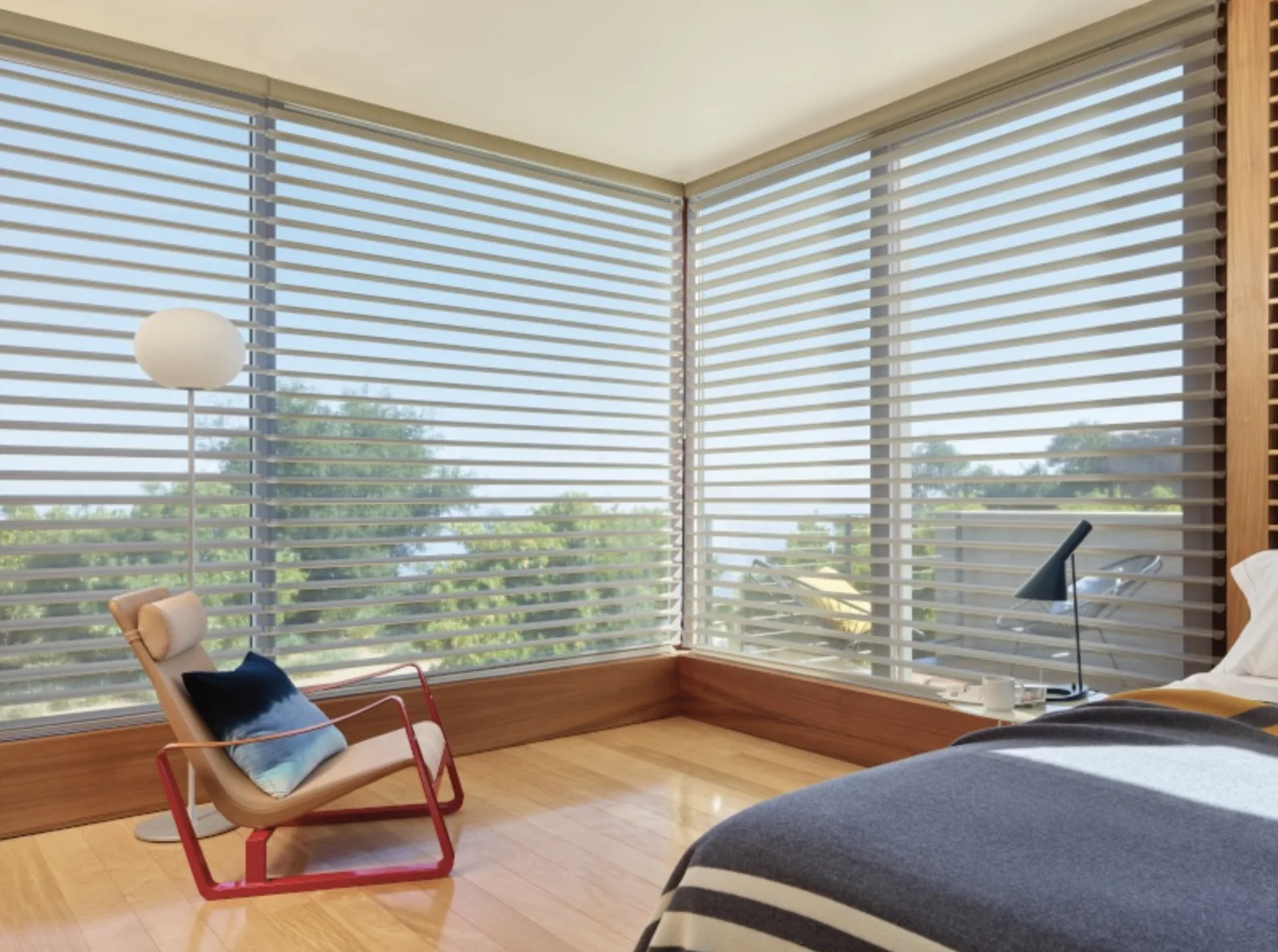
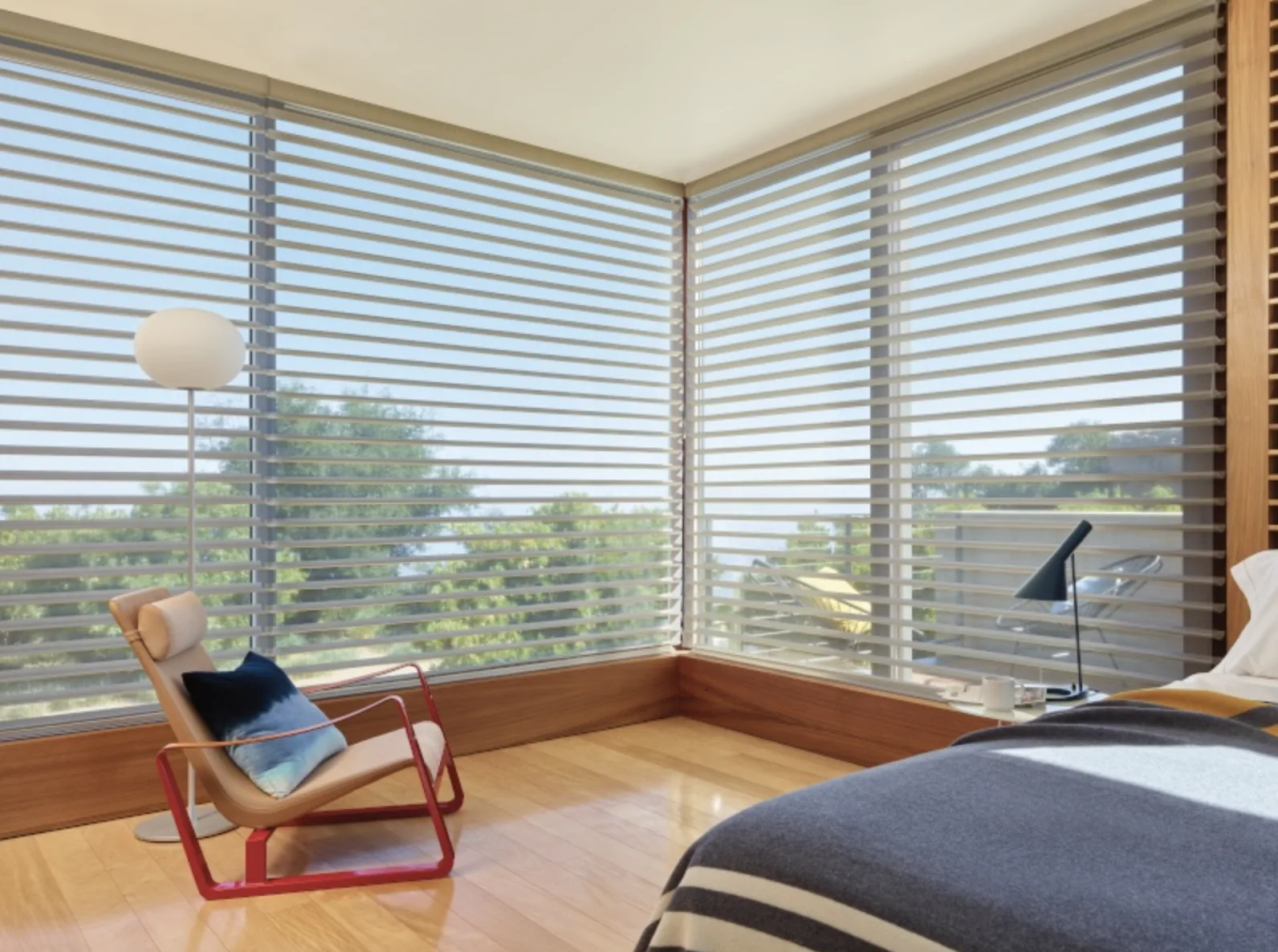
The short answer: Silhouette and Pirouette do the same job, and they do it beautifully. Both are Hunter Douglas sheer shadings that soften harsh daylight, keep your view to the outside, and give you privacy during the day with the vanes open. Both close at night for privacy, and both can run on PowerView motorization. The difference is how they are built and the look that creates. Silhouette floats S-shaped fabric vanes between two sheers, and the result is soft and timeless. Pirouette hangs contoured fabric vanes on a single sheer backing, and the result is bold and modern. I have personally owned both products, in my own homes, and they are two of my favorite window treatments Hunter Douglas makes. Which one belongs in your home depends on your rooms, your glass, and the look you love.
What Silhouette and Pirouette have in common
Both products belong to the Hunter Douglas sheer shadings family, and the shared idea is what makes people fall for them. Fabric vanes sit inside sheer fabric. Tilt the vanes open and light filters through the sheer, softened and spread through the room, while you keep your view out. That view is the whole point. A home feels more open when you can see the trees, the water, and the sky from your chair, and these shadings protect that feeling instead of covering it up. Tilt the vanes closed and the room is private.
Both shadings also protect your home while they let the light in. Hunter Douglas rates Silhouette as blocking up to 88 percent of harmful UV rays with the vanes open and 99 percent with the vanes closed. Pirouette blocks up to 81 percent with the vanes open and 99 percent closed. Floors, furniture, and art fade more slowly behind either one, and the room stays light and bright instead of cave-dark.
When you want the window completely clear, both shadings roll up into a fabric-wrapped headrail and disappear. And because so many newer homes have large windows that deserve a product built for them, both are made to cover big glass gracefully, which is exactly where they end up in most of the homes we install them in.
Silhouette: the timeless one
Silhouette is the original. Its S-shaped fabric vanes float between two sheer panels, one in front and one behind, and that double sheer is why the light in a Silhouette room feels the way it does. Harsh sun goes in one side and comes out the other as a soft glow. There are no hard lines in the light, no glare stripes across the floor. It is the most forgiving light of any product I sell, and it flatters every room it touches.
Silhouette vanes come in three sizes, 2 inch, 3 inch, and 4 inch, and the size you choose changes the view more than people expect. The 4 inch vane is my personal favorite, and the arithmetic is simple. On the same window, a 4 inch vane puts half as many horizontal lines across the glass as a 2 inch vane. Half the lines means more of your view survives, and Hunter Douglas itself rates the 4 inch vane as offering the best view-through in the line. If your home looks out at something worth seeing, that is the version to buy. Smaller windows can suit the 2 or 3 inch vane, where the finer scale matches the smaller glass.
Silhouette also carries one of the deepest fabric libraries Hunter Douglas offers, more than 150 fabrics and colors, and ClearView sheers are available when maximum view-through matters most. Living rooms, dining rooms, primary bedrooms, anywhere you want the light soft and the look classic: this is the product I reach for first.
Pirouette: the modern one
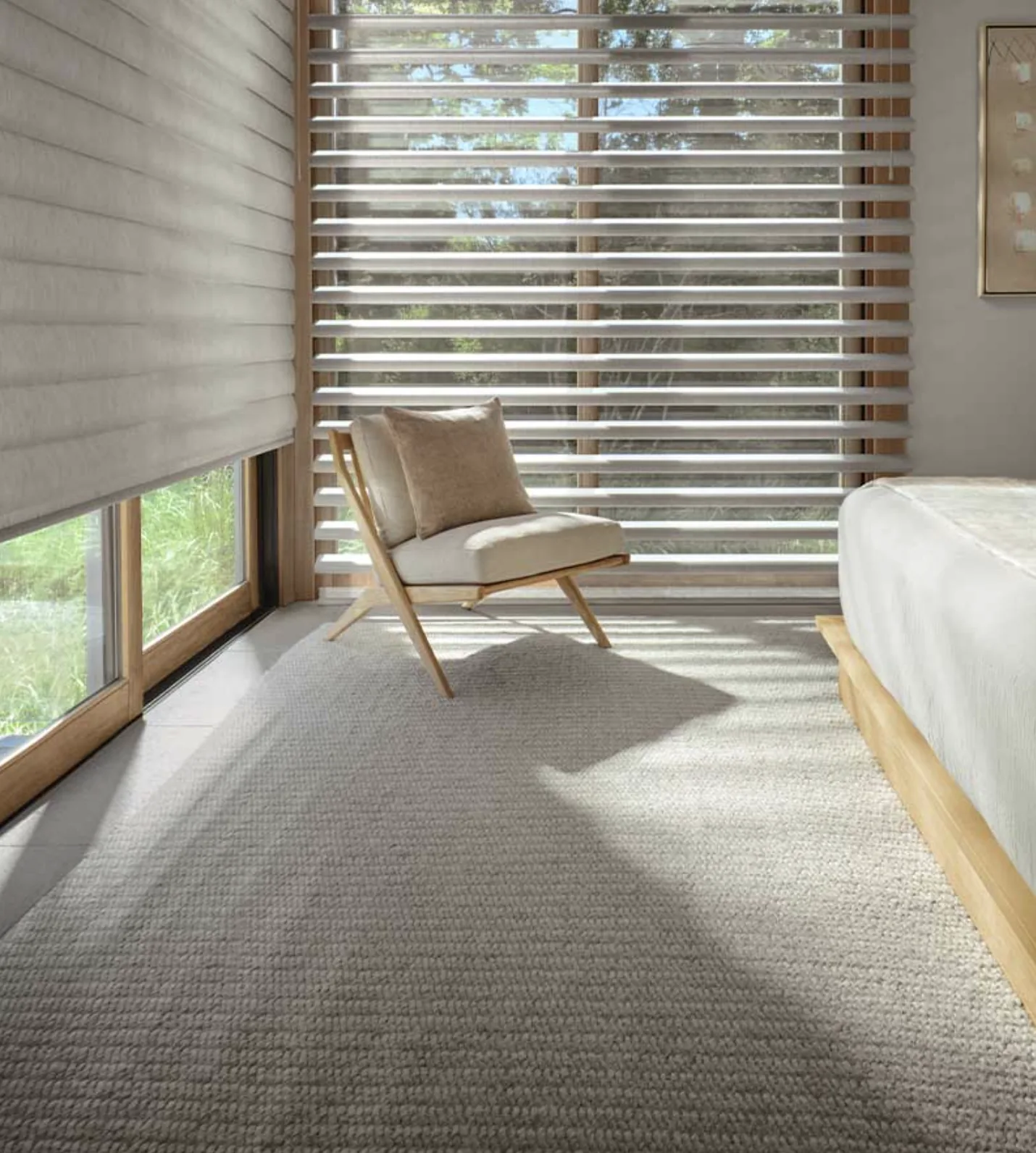
Pirouette takes the same idea and builds it differently. Its softly contoured fabric vanes attach to a single sheer backing, on Hunter Douglas's Invisi-Lift system, so the vanes appear to float. One sheer instead of two changes the character completely. The horizontal lines are stronger and more structured, the light takes on a sculpted quality, and because there is only one layer of sheer between you and the glass, the view out is strikingly clear.
The vanes are 5 inches, and at that size the lines are not a detail, they are the design. Pirouette looks like architecture. In a newer home with large windows, clean trim, and modern furniture, it does not decorate the window, it finishes it. Then there is my favorite trick it does. Close the vanes and they flatten, and the shade reads like a Roman shade, with the same tailored, folded beauty as Hunter Douglas Vignette. Open, it is a sheer shading with a view. Closed, it is a Roman shade. Two products in one window.
Pirouette comes in more than 90 fabrics and colors, in semi-opaque and room-darkening versions. Great rooms, modern builds, statement glass, rooms where the window treatment is part of the design rather than a backdrop: that is Pirouette territory.
Silhouette and Pirouette, side by side
| | Silhouette | Pirouette | |---|---|---| | Construction | S-shaped vanes between two sheers | Contoured vanes on a single sheer backing | | Vane sizes | 2 inch, 3 inch, 4 inch | 5 inch | | The look | Soft, timeless, diffused | Bold, structured, modern | | UV blocked, vanes open | Up to 88% | Up to 81% | | UV blocked, vanes closed | 99% | 99% | | Fabrics and colors | 150+ | 90+ | | Room-darkening option | Two-in-one design available | A Deux two-in-one design available | | Motorization | PowerView | PowerView | | Best for | Classic rooms, harsh light that needs softening, views you want to keep | Modern homes, large windows, design-forward rooms |
The honest trade-offs
Two things deserve plain talk, because they decide whether these products are right for your home.
Privacy is not the same as darkness. With the vanes closed, nobody sees into your home at night. Both products give you that, completely. But a sheer shading with its vanes closed still glows softly, and it will not make a bedroom dark at sunrise. If the room needs real darkness for sleeping, order the two-in-one version, which adds an independent room-darkening shade behind the sheer in the same headrail, or choose a different product for that room. I would rather tell you that here than have you learn it in your own bedroom.
Sheers are a refined product, not a rugged one. The fabrics are beautiful and durable for normal living, and mine held up for years in my own homes. But in a room where a large dog spends the day with its paws on the glass, or toddlers treat every window like a door, I will steer you toward something sturdier, and we have plenty of options. The right product in the wrong room is the wrong product.
What Silhouette and Pirouette cost
Both products are premium Hunter Douglas, and they sit in the same published price band. Our Hunter Douglas cost guide puts both Silhouette and Pirouette at roughly $500 to $1,400 per window for standard sizes, depending on fabric, with window size as the biggest single driver. Large glass prices like large glass, and a great room wall of windows is a different purchase than a bedroom window. PowerView motorization adds roughly $300 to $600 per window on top of either shade. Those are published dealer ranges, not a quote. The exact number for your windows comes after measuring, and it should, because size and fabric move these numbers more than any other choice you will make.
Both are better with PowerView
Both shadings are available with Hunter Douglas PowerView motorization, and on these two products it is the upgrade I recommend most. The vanes are the experience, and PowerView lets you tilt them open in the morning, close them for privacy at night, and run the whole room on a schedule or a scene, from the remote or the app. I have lived with motorized sheers and manual ones, and the motorized ones get used the way they deserve to be used, every day, instead of staying wherever they were left last week. PowerView is my favorite motorization system on the market, and our PowerView guide covers what it does in full.
Which one belongs in your home
Choose Silhouette if your rooms lean traditional or transitional, if your light is harsh and needs softening more than it needs shaping, if your view is the asset and the 4 inch vane's clean sight lines appeal to you, or if you want the deepest fabric library to match an existing room.
Choose Pirouette if your home is modern or newly built, if your windows are large and the treatment should feel like part of the architecture, if you love the folded look of Roman shades but refuse to give up your view during the day, or if you want the window itself to make a design statement.
And if you are torn, that is normal. These are sister products, and there is no wrong answer between them, only the one that fits your rooms. This is also exactly the decision that should happen in your home, with samples, in your light, against your furniture and your view. A photo on a screen cannot tell you how the double sheer of Silhouette will treat your afternoon sun, or whether Pirouette's bold lines sing in your great room or shout. Your windows can.
One service, wherever you are
Luxe Window Works serves North Idaho, Seattle's Eastside, and the Salt Lake area, and the service story is the same in every market. We bring Silhouette and Pirouette samples to your home for a free consultation, measure precisely, and install through our partnership with Hunter Douglas Installation Services. The measuring and the order are guaranteed accurate, the installation itself is guaranteed by Hunter Douglas for the first year, and both shadings carry the Hunter Douglas lifetime limited warranty to the original purchaser, with PowerView covered for five years. See window treatments in North Idaho, our Eastside service area, and our Utah service area, or go straight to booking a free in-home consultation. Stand in your own light, tilt the vanes yourself, and the choice between these two makes itself.
Common questions
What is the difference between Silhouette and Pirouette?
- Construction. Silhouette floats S-shaped fabric vanes between two sheer panels, front and back, which makes its light softer and its look timeless. Pirouette hangs contoured fabric vanes on a single sheer backing, which makes its lines bolder, its look more modern, and its view-through slightly clearer. Both filter light, keep your daytime view, close for privacy at night, and are available with PowerView motorization.
Which is better for large windows, Silhouette or Pirouette?
- Both are made for large windows and are installed on great room glass regularly. Pirouette's 5 inch vanes and structured lines hold their scale on very large windows especially well. Silhouette's 4 inch vane is the better choice when the view matters most, because it crosses the glass with half as many horizontal lines as the 2 inch vane. The right pick usually comes down to the room's style, and both should be seen on your own glass before deciding.
Do Silhouette and Pirouette provide privacy at night?
- Yes, with the vanes closed, both provide complete visual privacy at night. What they do not provide on their own is darkness. A sheer shading with closed vanes still lets a soft glow through, so a bedroom that needs real darkness should use the two-in-one version with an independent room-darkening shade in the same headrail, or a different product built for blackout.
Can Silhouette and Pirouette be motorized?
- Yes. Both are available with Hunter Douglas PowerView motorization, which raises and lowers the shading and tilts the vanes by remote, app, or schedule. PowerView adds roughly $300 to $600 per window over the same shade operated manually, based on published dealer ranges.
How much do Silhouette and Pirouette cost?
- Published dealer ranges put both at roughly $500 to $1,400 per window for standard sizes, depending on fabric. Window size is the biggest driver, and large windows cost substantially more than standard ones. Every shade is custom-made and quoted after measuring, so treat the range as a planning figure, not a price.
Do Silhouette and Pirouette block UV rays?
- Yes. Hunter Douglas rates Silhouette at up to 88 percent of harmful UV blocked with the vanes open and 99 percent with the vanes closed. Pirouette blocks up to 81 percent with the vanes open and 99 percent closed. That protection is a major reason these shadings suit rooms with hardwood floors, furniture, and art you want to keep from fading.