
Why Your Patio Door is Bleeding Energy (And What Actually Works in Northern Idaho)
From an installer's perspective with 24 years installing window treatments, I've walked through hundreds of homes where the patio slider was the single...
By Mark Abplanalp
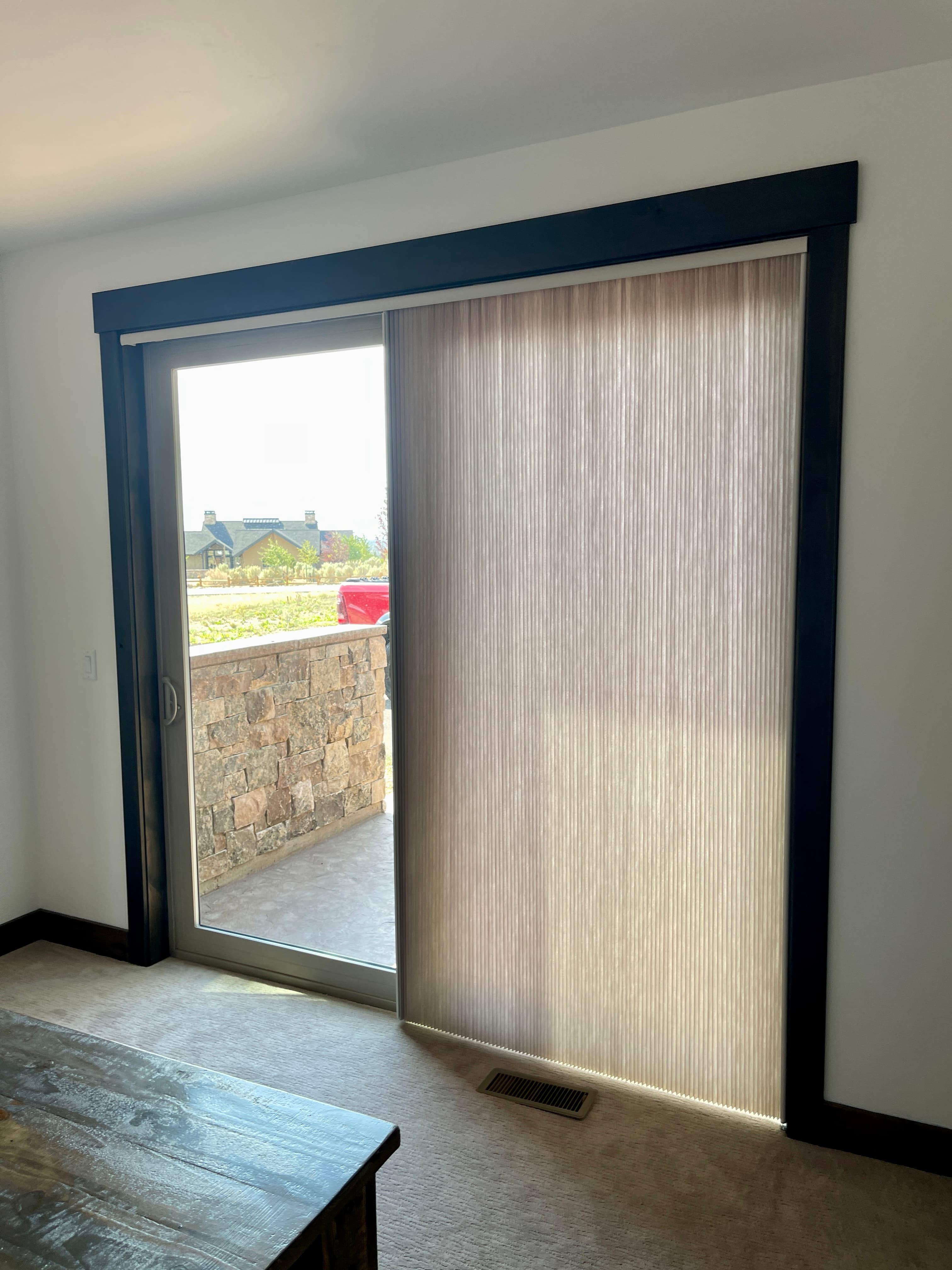
From an installer's perspective with 24 years installing window treatments, I've walked through hundreds of homes where the patio slider was the single biggest comfort problem—and the homeowner had no idea.
They'd complain about cold drafts near the door in January. About the living room being 8 degrees colder than the rest of the house. About curtains that never close all the way or plastic vertical blinds that rattle every time the furnace kicks on.
The culprit? Standard vertical blinds with thin PVC vanes that deliver virtually zero insulation, don't seal at the edges, and turn a 6-to-12-foot wall of glass into an energy hemorrhage point.
I'll break down exactly why traditional vertical blinds fail so predictably in Northern Idaho's climate, the measurable energy and comfort cost of that failure, and the specific solution I've installed across Coeur d'Alene, Post Falls, Hayden, and Sandpoint that actually solves the problem: vertical cellular shades built to move laterally across sliding doors like a blind—but with the insulating structure of a honeycomb shade.
This isn't about aesthetics or trends. It's about physics, building science, and what actually performs when you're heating a home through 20°F nights and cooling it through 95°F afternoons.
The Core Problem: Standard Vertical Blinds Are Essentially Decorative in Idaho's Climate
Most patio sliders get fitted with vertical blinds because they're the default option—cheap, readily available, and they stack to the side when you open the door.But here's what most installers won't tell you: plastic vertical blinds have an R-value near zero. They're thin sheets of vinyl or fabric hanging from a track with gaps at every edge and between every slat. They do almost nothing to slow heat transfer.
Why This Matters More for Patio Doors Than Regular Windows
A standard residential window might be 15-20 square feet of glass. A patio slider is often 40-80 square feet—sometimes more if you've got an 8-foot or 12-foot span.That means the energy loss through one untreated slider can equal the combined loss through 3-4 bedroom windows. When you cover those bedroom windows with insulating shades but leave the slider exposed with plastic blinds, you've left the biggest leak wide open.
From my experience measuring temperature differentials in Northern Idaho homes:
- Living rooms with untreated sliders run 6-10°F colder in winter than adjacent rooms with insulated window treatments
- West- and south-facing sliders in summer can push interior temperatures 8-12°F higher in the late afternoon
- Furnace runtime increases noticeably when sliders lack proper insulation—homeowners report 15-25% longer heating cycles during cold snaps
The Four Performance Failures of Standard Vertical Blinds
1. Zero Thermal Barrier
Thin PVC or fabric vanes have no trapped air pockets, no layered structure, and no meaningful resistance to heat flow. When outdoor temps drop to 15°F in January, that cold transfers straight through the glass and past the blinds into your living room.Most vertical blinds I've measured have an R-value under 0.5. For context, a single-pane window is around R-1. You're getting less insulation from the blind than you'd get from adding a second pane of glass.
Quality cellular shades, by contrast, deliver R-4 to R-7 depending on cell size and fabric—4 to 14 times the insulating performance.
2. Gaps That Don't Seal
Vertical blinds hang from a top track. The vanes overlap when closed but leave gaps:- At the top: Open track with airflow around the headrail
- At the sides: Vanes stop 1-2 inches from the window frame
- At the bottom: No seal against the sill—vanes hang freely
- Between slats: Light and air leak through every overlap
3. Noise from Airflow
Vertical blinds are lightweight and hang loosely. When your furnace or air conditioner runs, airflow from nearby registers causes the vanes to rattle, sway, and click against each other.I've had clients describe it as "like wind chimes every time the heat kicks on." In bedrooms adjacent to sliders, it disrupts sleep. In living areas, it's a constant low-level annoyance.
Cellular shades are tensioned within the frame and don't move with air currents. Operation is silent.
4. Aesthetic and Functional Degradation
PVC vanes warp, discolor, and crack over time—especially on west- and south-facing doors where UV exposure is intense. I've replaced vertical blinds that were only 3-4 years old because the vanes had yellowed, warped, or developed stress cracks at the clips.The plastic clips that hold vanes to the track fail frequently. Cord mechanisms jam or fray. Homeowners end up living with broken blinds because replacement is expensive and feels like throwing good money after bad.
The Measurable Cost of Poor Patio Door Insulation in Northern Idaho
Let's put numbers to this.Heating Season (November–March)
A typical 6-foot sliding door has roughly 48 square feet of glass. With standard low-E dual-pane glass (R-3) and no window treatment, you're losing significant heat through conductivity and convection.Adding plastic vertical blinds (R-0.3 to R-0.5) does almost nothing. Your effective R-value improves to maybe R-3.3—a 10% gain.
Adding vertical cellular shades (R-5 to R-7) brings your total system R-value to R-8 to R-10—a 150-250% improvement over the glass alone.
Real-world impact I've observed:
- Homeowners in Post Falls and Hayden report monthly heating cost reductions after upgrading slider treatments
- Living room temperatures stabilize 6-8°F higher without increasing thermostat settings
- Furnace runtime decreases 15-20% because the system isn't fighting a massive cold sink
Cooling Season (June–September)
West-facing sliders in Coeur d'Alene regularly hit 130-140°F surface temps on summer afternoons. That heat radiates into your living space, forcing the AC to run continuously.Plastic vertical blinds reflect some light but have no thermal barrier. The heat still transfers through.
Cellular shades with reflective backing (often called "solar" or "light-filtering" fabrics) block 60-80% of heat gain while still allowing diffused light.
Clients with west-facing sliders consistently report 8-12°F cooler living rooms in late afternoon after installing cellular shades. AC runtime drops noticeably.
The Solution: Vertical Cellular Shades Designed for Sliding Doors
Here's the key insight most homeowners miss: You don't have to choose between slider functionality and insulation.Vertical cellular shades are engineered specifically for patio doors. They operate exactly like traditional vertical blinds—moving laterally along a track to stack at one side—but they're built with honeycomb cell structures that trap air and create a true thermal barrier.
How Vertical Cellular Shades Work
Instead of flat plastic vanes, these shades use honeycomb-structured fabric panels that hang vertically and slide along a top track.- Cells run vertically (perpendicular to the floor), creating air pockets that resist heat flow
- Panels overlap when closed, with no gaps between them
- The entire system mounts inside the door frame, sealing at all four edges
- They stack compactly to one side when open, typically 6-8 inches depending on door width
From a performance standpoint, they're an entirely different category of product.
The Northern Idaho Climate Protocol: Why Vertical Cellular Shades Outperform Every Alternative
- We have a 60-70°F annual temperature swing (from sub-zero winter nights to 95°F+ summer afternoons)
- We have intense solar exposure (high-altitude sun, low humidity, minimal cloud cover in summer)
- We heat and cool homes for 9+ months per year (energy costs are ongoing and significant)
Benefit 1: True Insulating Structure
Honeycomb cells trap air in small pockets, creating a thermal break between the glass and your living space.- Single-cell fabrics: R-4 to R-5
- Double-cell fabrics: R-6 to R-7
I've measured 12-15°F temperature differences between the glass surface and the interior fabric surface on cold mornings. That trapped air is doing exactly what it's supposed to—slowing heat transfer.
Benefit 2: Sliding Door Functionality Preserved
Unlike roller shades or panel tracks (which either roll up or slide in front of the glass), vertical cellular shades move laterally and stack to the side just like traditional vertical blinds.You get:
- Full door access when open (no fabric hanging in the doorway)
- Minimal stack depth (6-8 inches vs. 12-18 inches for panel tracks)
- Smooth, quiet operation (even on 12-foot spans)
Benefit 3: Quiet Operation (Unaffected by Airflow)
Because the panels are secured within a track system and tensioned between top and bottom, they don't rattle, sway, or move when air registers kick on.I've installed these in homes with HVAC vents directly above sliders. Zero noise.
Benefit 4: Inside-Mount Installation = Airtight Performance
The entire system mounts within the door frame—top, bottom, and sides—creating a seal at every edge.This eliminates:
- Light leaks around the perimeter (critical for bedrooms)
- Air infiltration past the treatment (major heat loss source)
- Visual gaps that make blinds look sloppy or unfinished
Benefit 5: Precise Light and Privacy Control
Vertical cellular shades are available in multiple fabric opacities:- Light-filtering: Diffuses light, provides daytime privacy, allows soft glow (most popular for living areas)
- Room-darkening: Blocks 95-98% of light, near-total privacy (ideal for bedrooms)
- Blackout: Blocks 99%+ of light, complete privacy (rare for sliders, but available)
Unlike vertical blinds, which only rotate closed or open, cellular shades give you variable light control throughout the day.
Comparison Table: Plastic Vertical Blinds vs. Vertical Cellular Shades
| Feature | Standard Vertical Blinds (PVC) | Vertical Cellular Shades |
|---|---|---|
| R-Value (Insulation) | 0.3–0.5 (minimal) | 4.0–7.0 (significant thermal barrier) |
| Seal at Edges | No—gaps at top, sides, bottom, between slats | Yes—inside-mount seals all four edges |
| Noise from Airflow | High (vanes rattle near registers) | None (tensioned panels don't move) |
| Stack Depth When Open | 4–6 inches | 6–8 inches |
| UV Resistance | Poor (PVC warps, yellows, cracks) | Excellent (fabrics resist degradation) |
| Lifespan | 3–6 years typical (clips and cords fail) | 10–15 years typical (track systems durable) |
| Energy Impact (Heating) | Minimal—no meaningful heat retention | 25–40% reduction in heat loss through slider |
| Energy Impact (Cooling) | Low—reflects some light, no thermal barrier | 60–80% reduction in solar heat gain |
| Light Control | Binary (open/closed via rotation) | Variable (position anywhere along track) |
| Aesthetic Integration | Outside-mount projection, visible hardware | Inside-mount flush appearance, hidden hardware |
| Cost (Installed) | $200–400 for 6-foot slider | $600–1,200 for 6-foot slider |
Measurable Outcomes: What You Can Expect After Installation
Heating Season: Post-Installation Results (November–March)
- Living room temperature stabilization: 6–10°F warmer near the slider without increasing thermostat settings
- Reduced furnace runtime: 15–25% shorter heating cycles
- Monthly heating cost reduction: $60–120 average (based on client reports and utility bill comparisons)
- Comfort improvement: Eliminated cold drafts within 5 feet of the slider
Cooling Season: Post-Installation Results (June–September)
- Afternoon heat reduction: 8–12°F cooler living room temps on west-facing sliders during peak sun (3–6 PM)
- AC runtime reduction: 10–20% shorter cooling cycles
- Glare elimination: Diffused light prevents harsh afternoon glare on screens and furniture
Year-Round
- Noise elimination: No rattle, sway, or clicking when HVAC runs
- Privacy control: Light-filtering fabrics provide daytime privacy without closing blinds completely
- Aesthetic improvement: Clean, modern look that integrates with door frame
Mark's 3 Pro Tips for Solving Patio Door Problems in Northern Idaho
1. Inside-Mount is Non-Negotiable for Performance
If your slider has adequate frame depth (typically 2.5–3 inches), always install inside-mount.Outside-mount installations—where the treatment projects beyond the frame—leave gaps at the edges. You lose the airtight seal that makes cellular shades effective.
I've measured 3–5°F temperature differences between inside-mount and outside-mount installations on identical doors. The seal matters.
If your frame depth is insufficient, consider a hybrid installation where we mount the headrail to the ceiling and seal the sides and bottom within the frame. It's not as clean aesthetically, but it preserves most of the thermal performance.
2. Match Fabric Opacity to Room Function and Orientation
West- and south-facing sliders: Use light-filtering or solar fabrics with high reflectivity. These block heat while allowing diffused light. Room-darkening fabrics work but aren't necessary unless privacy is a priority.East-facing sliders (especially in bedrooms): Use room-darkening or blackout fabrics. Morning sun is intense, and you want sleep-conducive darkness.
North-facing sliders: Light-filtering fabrics are usually sufficient. North-facing glass gets minimal direct sun, so heat gain isn't a major concern.
3. Motorization Solves the "I Never Close Them" Problem
The biggest reason patio door treatments fail is people don't use them.Vertical blinds are annoying to operate—pulling cords, rotating wands, dealing with tangled chains. So homeowners leave them open, and the door bleeds energy 24/7.
Motorized cellular shades solve this. One button press (or scheduled automation via smart home integration), and the shades open or close in 15 seconds.
Clients who add motorization report near-100% daily use because there's zero friction. The shades close automatically at sunset in winter (retaining heat) and at 2 PM in summer (blocking afternoon sun).
Motorization adds $300–600 to installation cost but pays for itself in energy savings within 12–18 months in most Northern Idaho homes.
FAQ: Common Questions About Vertical Cellular Shades for Patio Doors
How much do vertical cellular shades cost compared to standard vertical blinds?
Standard plastic vertical blinds for a 6-foot slider typically cost $200–400 installed (cheap materials, minimal labor).Quality vertical cellular shades for the same slider run $600–1,200 installed, depending on fabric choice and motorization.
Yes, it's 2–3x the upfront cost. But the payback comes from:
- Energy savings: Will vary from home to home and based on daily usage of shade.
- Lifespan: Cellular shades last 10–15 years vs. 3–6 years for plastic blinds
- Avoided replacement: You're not re-buying vertical blinds every 4 years
Can these be installed on sliding doors that don't have much frame depth?
Frame depth is the limiting factor for inside-mount installations. Vertical cellular shades need 2.5–3 inches of depth depending on the track system.If your slider has less depth:
- Option 1: Outside-mount installation (mounts to the wall or ceiling above the door). You lose some thermal performance but still gain insulation benefits.
- Option 2: Hybrid mount (headrail mounts to ceiling, sides/bottom seal within frame). Preserves most thermal performance with a slight aesthetic compromise.
How do you clean cellular shades on patio doors?
Cellular fabrics are treated to resist dust, but sliders are high-traffic areas and accumulate dirt faster than standard windows.Cleaning process I recommend:
- Monthly dusting: Use a microfiber duster or vacuum with a soft brush attachment. Run it gently across the fabric surface to remove surface dust.
- Spot cleaning (as needed): Damp cloth with mild detergent for smudges or fingerprints. Blot, don't rub.
- Deep cleaning (annually): Some fabrics are ultrasonic-cleanable. Check manufacturer specs. Otherwise, gentle vacuuming is sufficient.
- Aggressive scrubbing (damages cell structure)
- Harsh chemicals (degrades fabric coatings)
- Soaking (cells trap moisture and take days to dry)
Are vertical cellular shades safe for homes with young children or pets?
Modern cellular shades are designed with child and pet safety in mind:- Cordless operation: Most systems use a wand, remote control, or motorization—no dangling cords
- Break-away cords (if corded): Tension devices that release under pressure
- Bottom-weighted panels: Panels hang vertically and don't swing freely like blinds
For pets, the panels are far more durable than plastic blinds. Cats can't easily climb fabric panels, and dogs won't damage them by brushing past. I've had zero reports of pet-related failures in over 15 years installing these.
Can I install these myself, or do I need professional installation?
Inside-mount cellular shades on sliders require precise measurement and installation. Small errors create gaps that kill performance.Critical steps:
- Exact frame measurements (width, height, depth at multiple points)
- Level headrail installation (even 1/8-inch off causes binding)
- Proper tensioning (bottom weight bar must sit flush with sill)
- Seal verification (check for light leaks at all edges)
Professional installation costs $150–300 depending on door size. It's worth it to avoid a $1,000 product that doesn't perform because it's installed wrong.
The Bottom Line: Your Patio Door Deserves Better Than Plastic Blinds
Standard vertical blinds are a poor solution for Northern Idaho's climate. They don't insulate, they don't seal, they rattle, and they fail predictably within a few years.Vertical cellular shades solve every one of these problems while preserving slider functionality.
If you're tired of:
- Cold drafts near your patio door in winter
- Living rooms that feel 8 degrees colder than the rest of the house
- Afternoon heat blasting through west-facing glass in summer
- Plastic blinds that rattle every time the furnace kicks on
- Buying replacement blinds every 3-4 years because the clips broke or the vanes warped
The difference is immediate and measurable. Your furnace runs less. Your living room stays warmer. Your AC doesn't fight losing battles on summer afternoons.
And you stop wasting money on a treatment that never worked in the first place.
Patio Door Solutions Across the Site
Patio doors aren't a single-product topic — different solutions fit different homes. Two product deep-dives that complete this guide:
Ready to solve your patio door problem?
Schedule a free in-home consultation with Luxe Window Works. I'll measure your slider, assess your frame depth, explain fabric options, and show you exactly what vertical cellular shades will deliver in your specific situation—no pressure, no hard sell, just honest advice from someone who's installed these in hundreds of Northern Idaho homes.
Call or text: 208-660-8643 Email: mark@luxewindowworks.com
Serving Coeur d'Alene /areas/sandpoint, Post Falls /areas/post-falls, Hayden, /areas/hayden Sandpoint, /areas/sandpointand surrounding areas
About the Author
Mark Abplanalp, Owner of Luxe Window WorksWith 24 years installing window treatments Mark specializes in matching products to regional climate challenges. He developed The Northern Idaho Climate Protocol™ after analyzing performance data from hundreds of installations in extreme temperature conditions. Mark prioritizes long-term performance and measurable energy outcomes over sales-driven recommendations. Luxe Window Works serves Coeur d'Alene, Post Falls, Hayden, Sandpoint, and surrounding communities.
Common questions
How much do vertical cellular shades cost compared to standard vertical blinds?
- Standard plastic vertical blinds for a 6-foot slider typically cost $200–400 installed (cheap materials, minimal labor). Quality vertical cellular shades for the same slider run $600–1,200 installed, depending on fabric choice and motorization. Yes, it's 2–3x the upfront cost. But the payback comes from energy savings that will vary from home to home and based on daily usage, lifespan (cellular shades last 10–15 years vs. 3–6 years for plastic blinds), and avoided replacement costs from not re-buying vertical blinds every 4 years. Most clients see full cost recovery within 18–30 months from energy savings alone.
Can these be installed on sliding doors that don't have much frame depth?
- Frame depth is the limiting factor for inside-mount installations. Vertical cellular shades need 2.5–3 inches of depth depending on the track system. If your slider has less depth, you have two options: outside-mount installation, which mounts to the wall or ceiling above the door and loses some thermal performance but still gains insulation benefits; or a hybrid mount where the headrail mounts to the ceiling while sides and bottom seal within the frame, which preserves most thermal performance with a slight aesthetic compromise. Every door gets measured before quoting because frame depth varies significantly, especially in older homes or custom builds.
How do you clean cellular shades on patio doors?
- For monthly maintenance, use a microfiber duster or vacuum with a soft brush attachment to remove surface dust. For spot cleaning, use a damp cloth with mild detergent for smudges or fingerprints—blot, don't rub. For annual deep cleaning, some fabrics are ultrasonic-cleanable; otherwise, gentle vacuuming is sufficient. Avoid aggressive scrubbing (damages cell structure), harsh chemicals (degrades fabric coatings), and soaking (cells trap moisture and take days to dry). The fabrics are far more durable than they look—10-year-old shades in high-use areas can still look clean with basic monthly maintenance.
Are vertical cellular shades safe for homes with young children or pets?
- Modern cellular shades are designed with child and pet safety in mind. Most systems use a wand, remote control, or motorization with no dangling cords. If corded, they include tension devices that release under pressure. Bottom-weighted panels hang vertically and don't swing freely like blinds. Motorized systems are the safest option with no cords, no manual operation, and no pinch points. For pets, the panels are far more durable than plastic blinds—cats can't easily climb fabric panels, and dogs won't damage them by brushing past.
Can I install these myself, or do I need professional installation?
- Inside-mount cellular shades on sliders require precise measurement and installation. Small errors create gaps that kill performance. Critical steps include exact frame measurements at multiple points, level headrail installation (even 1/8-inch off causes binding), proper tensioning so the bottom weight bar sits flush with the sill, and seal verification to check for light leaks at all edges. Professional installation costs $150–300 depending on door size. It's worth it to avoid a $1,000 product that doesn't perform because it's installed wrong.
Have Questions About Your Windows?
Our team offers free in-home consultations throughout Northern Idaho. Get personalized advice for your specific situation.