Window Treatments for Northern Idaho Second Homes — What to Look for in an Installer When You're Not There
When your second home is in Coeur d'Alene, Hayden, or Sandpoint and you're hundreds of miles away, the installer who measures, orders, and installs your window treatments has to be someone you trust completely. Here's what to look for in an installer when you're not on-site — and what's at stake when you choose wrong.
By Mark Abplanalp
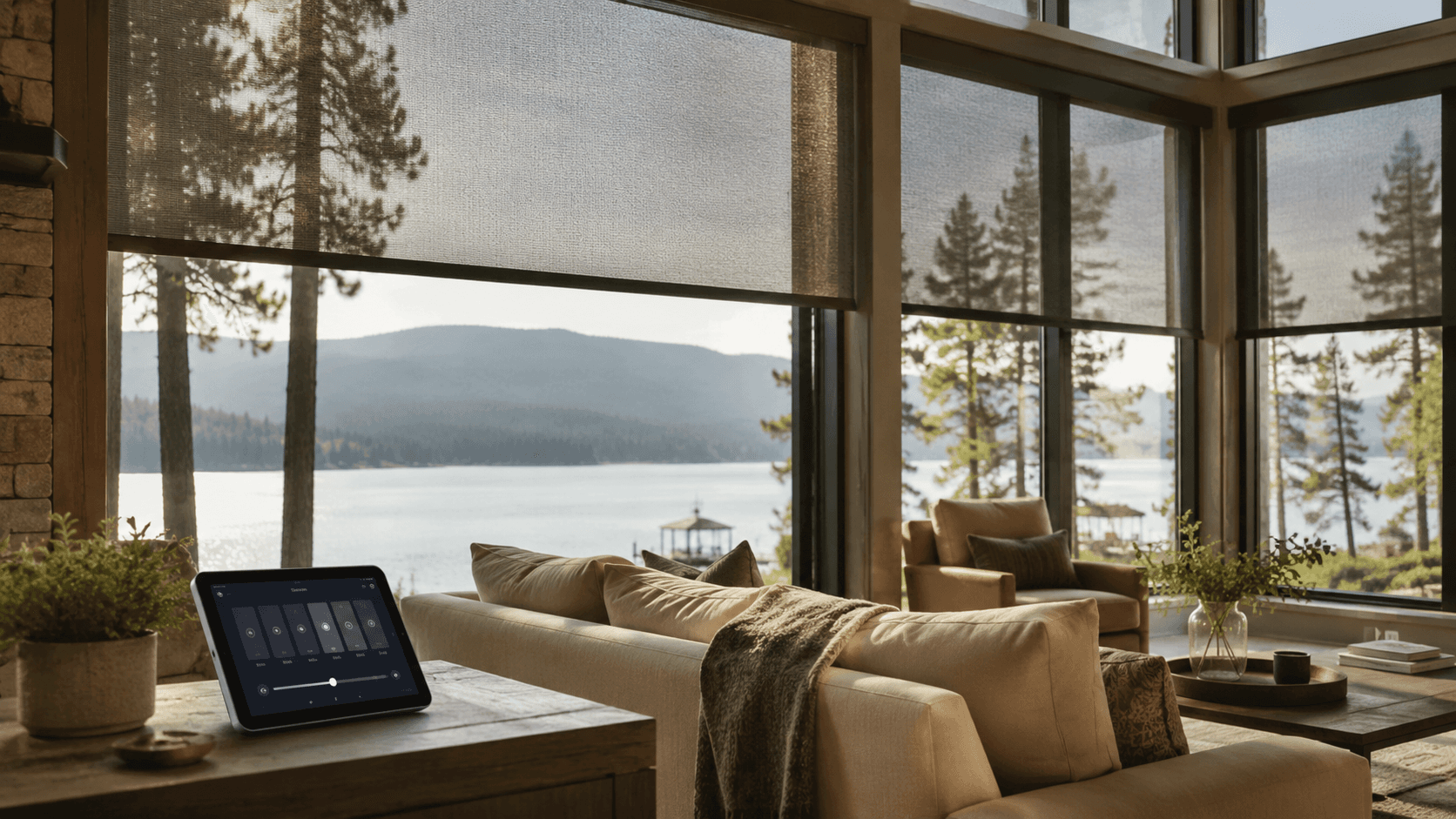
There's a particular kind of homeowner I work with every summer in Northern Idaho: someone whose primary residence is in Seattle, the Bay Area, Denver, or somewhere further. Their home in Coeur d'Alene or on Hayden Lake or up near Sandpoint is the place they come to in July and August. The place they bring family for holidays. The place their grandkids learn to fish. It's their home — but they're only there a few weeks or a few months out of the year.
When these owners need window treatments installed, they face a problem most local homeowners don't: they're not there during the project. They're choosing an installer based on phone calls, referrals, and online reviews. They're approving fabric choices and motor systems from another state. They're trusting someone with their second-most-important real estate investment without ever being on-site to supervise.
This article is about what to look for when you're that homeowner — and why it matters more than you might think.
What Makes Second-Home Installations Different
A primary-residence install is straightforward. You're home during the measure. You're home during the install. If something feels off, you catch it on day one and we fix it before we leave.
A second-home install introduces friction at every step:
- You can't be there to verify measurements before the order is placed
- You can't be there to physically see fabric samples in your space's lighting
- You can't be there to confirm the install is correct
- If something fails six months after the install, you might not discover it until your next visit
- Coordination requires working across time zones, travel schedules, and property access
Most of these challenges are solvable with the right installer and the right process. But they're real, and they're the reason second-home owners need to think differently about who they hire.
What Can Go Wrong (And Usually Does, With the Wrong Installer)
I'm going to be direct about what I've seen second-home owners deal with when they hired the wrong company:
Wrong measurements that nobody catches. A treatment is ordered, arrives weeks later, and only then does someone realize it doesn't fit. The owner — three states away — gets a phone call and has to make decisions in real time about a problem they can't see.
Sub-contracted installation. The salesperson who quoted the job is not the installer who shows up. The installer doesn't know what was promised. Quality is inconsistent. When something fails later, nobody owns it.
Wrong product specs for the climate. A treatment that works fine in a primary residence in California fails in a Hayden Lake home that sees -10°F winters and unoccupied summer UV exposure. Fabrics fade, motors fail, components warp.
No follow-up. Six months after install, a motor stops working. The owner calls the company and gets routed through a national 800 number. Service takes weeks to schedule. Nobody on-site to handle it in the meantime.
Cheap motors that fail when you're away. This one's specific. A budget motor fails in March. You don't visit until July. You arrive to find half your shades stuck open or closed. You can't run the home the way it was designed to run.
These aren't theoretical. I've heard versions of all of these from second-home owners who came to me after a bad experience with someone else.
What to Look For in a Second-Home Installer
The installer matters more than the brand on the box. Here's what I'd look for if I were in your position:
A Local Owner-Operator, Not a National Chain
When you call a national chain, you're routed through a sales process designed for volume. When you call a local owner-operator, you're talking to the person who'll be in your home doing the work. That accountability matters when you're not there to verify it.
Direct Installation — No Sub-Contractors
Ask explicitly: "Will you personally be installing this, or is it sub-contracted?" If the answer is sub-contracted, the quality control loop has a gap in it. The salesperson sells, the sub-contractor installs, and nobody owns the outcome when something goes wrong.
Climate-Specific Product Knowledge
Northern Idaho climate is brutal on materials. Winter humidity, summer UV at altitude, temperature swings, occasional ice or snow load on exterior products — these stress products in ways most installers in milder climates never see. The right installer will spec materials that handle the specifics. The wrong installer treats Idaho the same as anywhere else.
Communication That Works Across Distance
For second-home owners, communication is everything. Look for an installer who'll:
- Send detailed written specs you approve before ordering
- Ship physical fabric samples to your primary residence so you can see them in your lighting
- Document each project milestone with photos or video
- Walk you through the completed install via video call if you can't be there
- Stay in direct contact rather than routing through layers
Reputation That Extends Beyond the Local Market
A local installer with a reputation contained to one zip code is fine for primary residences. For second-home owners, the better signal is an installer whose reputation has reached beyond the immediate market — meaning customers in other places have specifically sought them out.
A Note on Reputation
Most window treatment installers serve a 30-mile radius. That's the nature of the business — local trust, local referrals, local market. Word-of-mouth typically doesn't travel further than that.
Occasionally, it does. We've had customers from outside Northern Idaho specifically request our work — meaning the trust signal traveled across state lines on its own. Here's a recent review from a customer in Oregon who chose us for her home:
"Mark at Luxe Window Works did an incredible job on the shutters in my office and the shades on my stair landing. The quality and attention to detail are amazing, and he made the whole process super easy. Mark is professional, friendly, and really knows his stuff. Everything turned out even better than I imagined — highly recommend!"
— Justine M., Yelp Review
That kind of reach matters for second-home buyers in two ways. First, it's evidence that the installer's reputation is built on consistent work — not on local marketing or geographic proximity. Second, it suggests the installer has experience working with customers who aren't physically present during every step.
Practical Coordination Tips for Second-Home Owners
If you've found an installer you trust, here's how to make the project run smoothly:
Schedule During Your Visits When Possible
The cleanest scenario is having the measure, sample review, and final installation all happen during a single visit. This isn't always possible, but when it is, it eliminates most coordination friction.
Use Property Managers or Caretakers for Access
Most second-home owners we work with have a property manager, caretaker, contractor, or trusted neighbor who can let us in. This works well as long as expectations are clear: the access person isn't responsible for making decisions about the work — they're just handling access.
Approve Specs in Writing Before Anything Is Ordered
For a primary residence, a verbal confirmation might be fine. For a second-home install, get every spec in writing before fabric is cut or product is ordered. Window dimensions, fabric selections, mount type, motor brand and model, programming preferences, scheduled scenes — all of it.
Request Photo or Video Documentation
A good installer will document each project milestone with photos. For motorized systems, ask for a video walkthrough of programming after install — that way you can practice the operation before you arrive.
Plan Motorization Carefully
For second-home owners, motorization deserves extra thought. The advantages are real: scheduled scenes give an occupied appearance even when you're not there, which has security value. Voice and app control let you adjust shades when you arrive without manually opening every window. Battery-powered motors mean no wiring requirements.
The trade-off is battery replacement. Battery motors last 12–18 months between charges depending on use. For a second home you visit once or twice a year, plan to replace batteries during each visit so you're not surprised by dead shades on arrival.
Frequently Asked Questions
Can you handle the installation without me being there?
Yes — this is one of the most common scenarios we handle. The process: written specs you approve before ordering, photo documentation throughout the project, coordinated access through your property manager or trusted contact, and a video walkthrough of the completed install. We've installed in second homes where the owner wasn't physically on-site at any point during the project. With clear communication upfront, it works smoothly.
We're only at our second home a few weeks per year. Should we choose motorized or manual?
For second-home owners specifically, motorization is usually worth the investment. The biggest reason is scheduled operation — you can set shades to lower at sunset to give an occupied appearance even when you're not there. Beyond security, motorization makes arrival easier: you can raise every shade in the house from one wall switch instead of working your way through every room. Battery motors last 12–18 months and require periodic replacement, which you can handle during your visits.
Our lake home gets hammered by UV when we're not there. How do we protect interiors?
Sun damage to furniture, flooring, and artwork is a real concern in unoccupied second homes — particularly lakefront properties with high reflective glare. We typically spec solar shades with strong UV-block ratings on the worst-exposed windows. Solar shades let you preserve the view when you're there and block damaging UV when you're not. For maximum protection, pair solar shades with motorized scheduling that lowers them automatically during peak sun hours.
Will my warranty be honored if I'm only at the home a few weeks a year?
Yes. The manufacturers we work with — Alta, Norman, Lafayette, and others — provide standard warranties that aren't affected by occupancy patterns. More practically, Luxe Window Works handles warranty claims and service calls directly for every installation we do. You don't have to navigate manufacturer customer service yourself.
How do you handle access to the property when we're not there?
Most second-home owners give us coordinated access through a property manager, caretaker, neighbor, or contractor they're already working with. We've also worked with smart-lock systems that allow timed access for installations. Whatever access method fits your security comfort level, we can work with it. The important thing is that the access contact isn't making decisions on your behalf — they're just enabling us to do the work you've already approved in writing.
What if something fails when we're not there?
Call us. We'll diagnose remotely if possible — often a dead battery or a tripped motor that we can talk you through resetting. If service is required, we can arrange a visit through your property manager or access contact. The advantage of working with a local owner-operator is that you're not navigating a national service hotline — you're calling the same person who installed the work, and that person owns the outcome.
Luxe Window Works installs custom window treatments throughout Northern Idaho — Coeur d'Alene, Post Falls, Hayden, Rathdrum, Sandpoint, and surrounding communities. We work regularly with second-home and vacation-property owners whose primary residence is out of the area. For a free consultation on your Northern Idaho property, call us or request a visit through our consultation form.
Have Questions About Your Windows?
Our team offers free in-home consultations throughout Northern Idaho. Get personalized advice for your specific situation.