Bedroom Window Treatments in Northern Idaho: A Complete Guide to Sleep, Light, and Privacy
The bedroom is the one room where window treatments actually affect your daily life — your sleep, your privacy, your morning light, your energy bills. Here's what works, what doesn't, and how to layer treatments for the best result.
By Mark Abplanalp
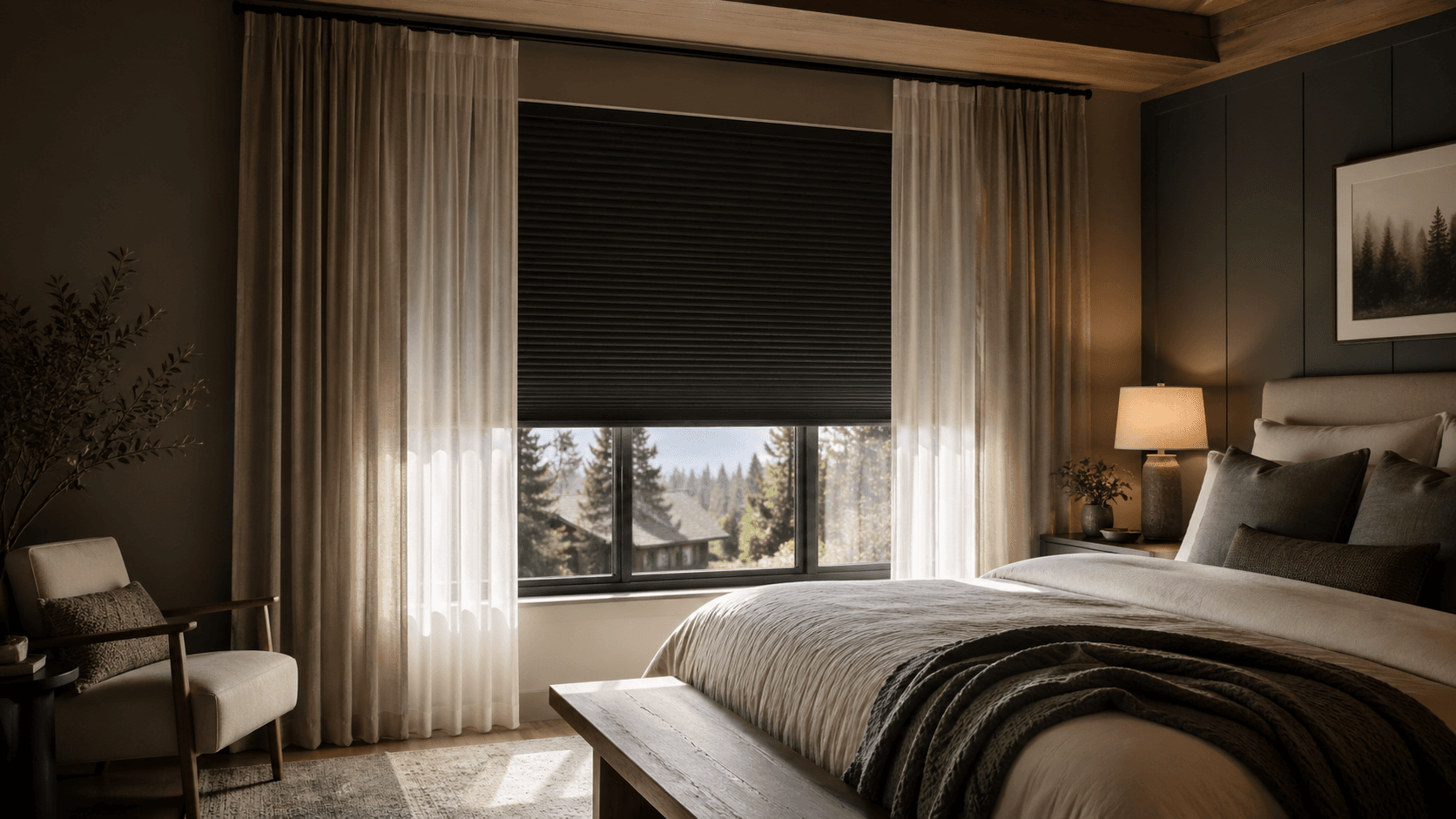
The bedroom is the one room where window treatments stop being decoration and start being function. Light wakes you up too early. Glare hits your face during weekend sleep-ins. Streetlights keep you up. Neighbors can see in. Your HVAC fights summer heat through west-facing windows until your bill creeps up every August.
Most window treatment articles treat all rooms the same. They shouldn't. Living rooms are about light and view. Kitchens are about moisture and easy cleaning. Bathrooms are about privacy and humidity. Bedrooms are about sleep — and sleep is the highest-stakes function any room in your home performs.
After 23 years of installing window treatments in Northern Idaho homes, I can tell you that bedroom decisions get made with the least information and the most regret. People pick what they picked in the living room and find out six months later that the morning sun is still cutting through, or the streetlight is still glowing on the ceiling, or the shades they thought were blackout actually let a halo of light around every edge.
Here's what actually works for bedrooms in Northern Idaho — and what to avoid.
The Three Things Every Bedroom Window Treatment Has to Solve
Before picking products, get clear on what your bedroom windows are actually doing wrong. Most bedrooms have three problems competing with each other.
Light Control
Northern Idaho summers mean five-thirty AM sunrises in June and July. Without proper light blocking, your bedroom is fully lit by the time you'd want to be sleeping for another two hours. East-facing bedrooms get the worst of it. South-facing bedrooms get less direct morning light but more all-day glow. West-facing bedrooms stay lit until nine-thirty PM in summer, which makes early bedtimes hard for kids and shift workers.
Privacy
Bedrooms are where privacy matters most. Daytime privacy and nighttime privacy are different problems. Daytime is about sheers, light filtering, or treatments that let light in without letting eyes through. Nighttime is harder — once interior lights are on and exterior is dark, almost any non-blackout treatment becomes see-through from the outside.
Temperature
Northern Idaho's climate hits bedrooms hard from both directions. Winter cold radiates through glass at night, making rooms feel chilly even with the heat running. Summer heat builds up in west-facing rooms through long evenings, making bedrooms uncomfortable until well past midnight. Cellular shades address both — and they address them better in bedrooms than in any other room because bedroom doors are usually closed, which means the air pocket the shade creates actually traps air against the glass.
The Layered Approach: What Pros Actually Recommend for Bedrooms
The single biggest mistake homeowners make in bedrooms is picking one window treatment to solve all three problems. It rarely works. The window treatments that block light well don't filter light beautifully. The treatments that filter light beautifully don't block it. The treatments that insulate well aren't always the most attractive.
The professional answer for bedrooms is layering — usually two treatments per window, working together.
Layer One: The Light Filter
The first layer handles daytime function. Light filtering cellular shades, transitional shades like Lafayette Allure, or sheer roller shades let in soft natural light while preserving daytime privacy. This is the layer that's down most of the time you're awake in the room.
Layer Two: The Blackout
The second layer handles sleep function. Either blackout cellular shades behind the light filter, blackout drapery in front of it, or a dual-shade banded system that combines both functions in a single unit. This layer comes down for sleep and goes up when you wake.
The combination matters. Light filtering alone doesn't give you blackout. Blackout alone doesn't give you a pleasant daytime room. Layering means the bedroom works for both functions without compromise.
The Best Bedroom Window Treatments for Northern Idaho
Different bedrooms need different solutions. Here's what holds up best in this climate, for the function it's solving.
Blackout Cellular Shades
Honeycomb cellular shades in blackout fabric are the most popular bedroom treatment we install in Northern Idaho. They're insulating, blackout-rated, and clean-looking. The cell structure traps air against the glass, which makes a meaningful difference on cold winter nights and hot summer afternoons.
The catch is that side-channel light leakage is real with cellular shades. The fabric itself blocks light completely, but the gap between the shade and the window frame on the sides lets light through. For bedrooms where true blackout matters — shift workers, light sleepers, parents trying to keep babies asleep — the side-channel issue needs to be addressed at install. Either with side tracks, with an inside-mount that fits tight to the frame, or by layering with a blackout drape that covers the gaps.
Dual-Shade Banded Systems
Banded shades alternate solid and sheer horizontal stripes. Roll the shade one way and the solid bands align to block light. Roll it the other way and the sheer bands align to let light through. One shade does both jobs.
For bedrooms, this is a strong option when you want a clean modern look without the visual weight of two layered treatments. The trade-off is that banded shades aren't true blackout — they're light-reducing rather than light-blocking. For a primary bedroom where you want morning light at your discretion but don't need pitch-black for sleep, they're an elegant solution. For a bedroom where you need genuine darkness, layer with drapery or pick blackout cellular instead.
Plantation Shutters With Drapery
Shutters in the bedroom are an underrated choice. The full-louver privacy when closed is excellent. The light control through tilt is precise. The look is built-in and timeless. The energy performance is solid because shutters with closed louvers create their own air pocket.
The drawback for blackout is that shutters have small gaps between louvers that light can sneak through, particularly in the morning. The fix is layering shutters with a blackout drape — closed shutters give privacy and partial light control, and the drape closes when needed for full darkness. This combination is common in higher-end Northern Idaho bedrooms because it's beautiful and it works.
Roller Shades With Side Channels
For modern bedrooms that want a clean, minimal look, blackout roller shades with side channels handle the blackout function reliably. The side channels eliminate the gap that compromises blackout cellular shades. The roller mechanism is simple and durable.
The visual weight of a fully closed blackout roller is more substantial than cellular fabric, which some homeowners like and some don't. For modern, design-forward bedrooms, this is the cleanest option. For traditional bedrooms, it can read more commercial than residential.
Drapery as the Blackout Layer
Drapery alone can do bedroom blackout if the fabric is rated for it and the panels are wide enough to overlap the window edges. The advantage is softness — drapery adds warmth and acoustic dampening that hard window treatments don't.
The disadvantage is that bedroom drapery has to actually close every night and open every morning, which means hardware needs to be smooth and panels need to be sized correctly. We've seen plenty of bedrooms where the drapery looks beautiful but the homeowner stopped using it because the rod binds or the panels don't reach the wall.
Motorization in the Bedroom: Worth It or Overkill?
Motorized bedroom shades fall into two clear groups: people who love them and people who don't understand why anyone would pay extra. The dividing line is usually whether the homeowner has tried them.
When Motorization Genuinely Earns Its Cost
Bedrooms with high windows, transom windows, or arched windows where pulling cords or wands isn't practical. Bedrooms where shades need to operate over a bed or other furniture you can't easily reach behind. Primary bedrooms where the homeowner wants to wake up gradually with shades opening at sunrise on a schedule. Accessibility situations where the homeowner has limited mobility and reaching for cords is genuinely difficult.
When Motorization Is Probably Not Worth It
Standard-height bedroom windows that are easy to reach. Bedrooms where shades stay in one position most of the day. Homes where the homeowner doesn't use smart home systems and doesn't want to. Single-window bedrooms where the cost-per-window of motorization is the highest.
The other consideration in Northern Idaho is temperature. Battery-operated motorized shades work in cold rooms, but battery life shortens in extreme temperatures. For unheated guest rooms or vacation homes that drop below freezing in winter, hardwired motors hold up better.
Common Bedroom Window Treatment Mistakes
After two decades of bedroom installs, the same mistakes show up repeatedly.
Confusing Room-Darkening With Blackout
Room-darkening fabric reduces light. Blackout fabric eliminates it. The terms get used interchangeably by retailers but they mean different things. If you need genuine darkness, ask specifically for blackout-rated fabric, and confirm the install handles edge light leakage. Otherwise you'll spend hundreds per window and still have a bedroom that's dim, not dark.
Skipping the Blackout Layer to Save Money
Cellular shades alone in a bedroom is the most common compromise we see. Homeowners price out a layered solution, see the higher number, and pick the cellular shades alone. Six months later they're calling to ask about adding drapery because the morning sun is still waking them up at five forty-five.
If the budget doesn't cover layering both layers right now, install the blackout layer first and add the light-filter layer later. Most homeowners get this backwards.
Picking Bedroom Treatments Based on Living Room Style
The living room and the bedroom have fundamentally different functions. What looks beautiful and works well in a living room often fails in a bedroom because the priorities are different. Light filtering shades that look elegant in a south-facing living room with a view will leak too much morning light in an east-facing bedroom. Match the treatment to the function, not the visual style of the rest of the house.
Not Accounting for Streetlights
In neighborhoods with streetlights, the nighttime light source is constant, not seasonal. A bedroom that faces a streetlight needs blackout-rated treatments year-round, not just in summer. This catches a lot of homeowners who picked treatments based on natural light alone and discovered the streetlight problem after install.
Frequently Asked Questions
What's the best window treatment for a bedroom in Northern Idaho?
For most bedrooms, the strongest combination is blackout cellular shades layered with light-filtering drapery or sheers. The cellular shades handle insulation and blackout. The outer layer handles daytime softness and privacy. For homeowners who want a single-treatment solution, blackout roller shades with side channels are the cleanest option that doesn't require layering.
Do blackout shades really block all light?
The fabric itself blocks all light. The challenge is the install — gaps between the shade and the window frame let light through on the sides, top, and bottom. For genuine blackout, either choose treatments with side channels, drapery that overlaps the window edges, or layered systems that cover the gaps. A correctly installed blackout shade with attention to edge sealing can produce true darkness. A standard inside-mount blackout shade typically cannot.
Are motorized bedroom shades worth the cost?
Motorization makes sense in bedrooms with high or hard-to-reach windows, for homeowners with mobility limitations, or for anyone who wants scheduled gradual sunrise lighting. For standard-height windows that get operated once or twice a day, motorization is more about preference than necessity. Battery-operated motors work well for retrofits; hardwired motors work better in extreme temperatures and high-use situations.
Should I get the same window treatments in every bedroom?
Not necessarily. Each bedroom has different light, privacy, and use considerations. A primary bedroom with east-facing windows has different needs than a guest room used twice a year or a child's bedroom with a streetlight outside. Match the treatment to the room's actual function rather than picking one solution for the whole house.
What window treatment is best for a child's bedroom?
Child bedrooms have specific requirements: cordless operation is mandatory under federal safety law for any blinds or shades sold in the United States, blackout is usually a high priority for nap times, and durability matters because kids and treatments don't always coexist gently. Cordless cellular shades or roller shades in blackout fabric are the most common solution. Avoid drapery in young children's rooms — the cords and rods create tip-over risks.
What This Costs in Northern Idaho
Bedroom window treatments range widely depending on the layered approach you choose. A single window with quality blackout cellular shades typically runs $300 to $500 installed. Adding drapery as a second layer adds $400 to $1,200 per window depending on fabric and panel size. Plantation shutters in bedrooms run $500 to $900 per window. Motorization adds $200 to $400 per window for battery-operated motors and $400 to $700 for hardwired.
A complete bedroom — primary bedroom with two windows, fully layered, with motorized shades and high-quality drapery — typically lands between $2,500 and $4,500 in our Northern Idaho market. Less ambitious solutions land between $800 and $1,500 per window covered.
The biggest cost mistake we see is buying twice. Homeowners pick a budget-friendly solution that doesn't actually solve the bedroom's problems, live with it for a year, and then replace it with what they should have installed the first time. Spending more upfront to get the layered system right saves money over a five-year horizon almost every time.
If you're working through bedroom window treatments in Coeur d'Alene, Post Falls, Hayden, Rathdrum, or anywhere in Northern Idaho, we offer free in-home consultations. Bring the room's actual challenges — sun direction, streetlights, sleep schedules, privacy concerns — and we'll work out a layered solution that actually fits how you use the room.
Have Questions About Your Windows?
Our team offers free in-home consultations throughout Northern Idaho. Get personalized advice for your specific situation.